

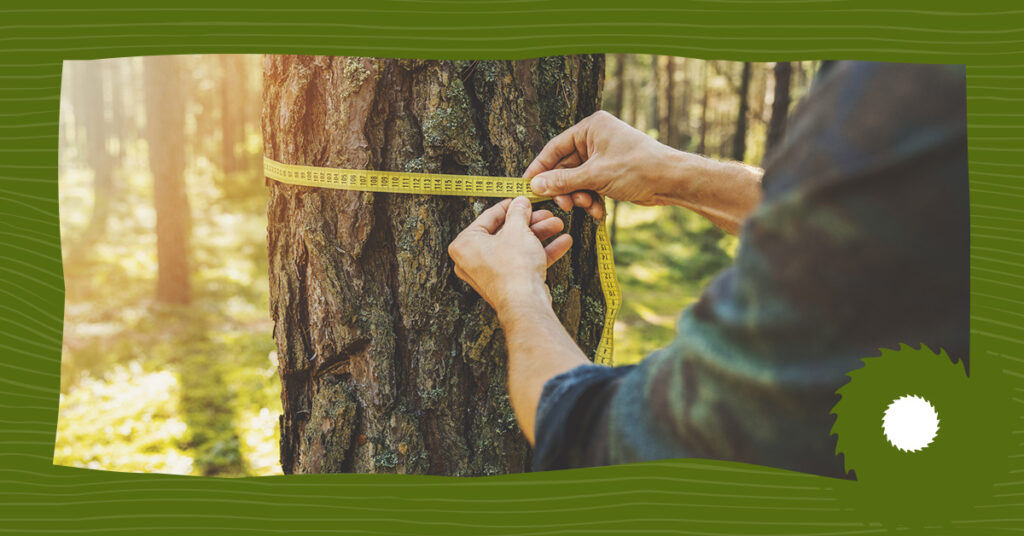
Understanding a tree's diameter is critical for estimating timber volume and determining the value of the trees on your property. Fortunately, measuring diameter is straightforward once you know the method to use. With a few simple tools and consistent techniques, you can collect accurate measurements and use them to negotiate a timber sale.
This guide walks you through how to measure the diameter of a tree trunk and provides practical tips to improve accuracy and streamline your evaluations.
What Is DBH for Trees?
Diameter at breast height, or DBH, is the standard measurement used to determine the width of a tree's trunk. Foresters determine this number by measuring the trunk at 4 1/2 feet above the ground. This height keeps measurements consistent across trees and helps ensure accurate timber valuation. When working on sloped ground, take the measurement 4 1/2 feet from the uphill side to maintain that consistency.
A few additional guidelines help you collect a reliable DBH.
- Bumps or irregular growths: Measure above or below swellings, knots or deformities where the trunk returns to a uniform shape. Record the smallest true diameter in that section to avoid inflated readings.
- Splits: If the trunk divides into multiple forks, measure below the lowest split where the tree is still a single, continuous stem.
Why Tree Diameter Is Important
Tree diameter is a primary indicator for assessing a tree's growth rate, age and volume. Here are some points to consider when measuring.
- Estimate value and volume: Correct diameter measurements are fundamental to determining your tree’s value. Larger diameters generally result in greater wood volume and board-foot yields during harvesting.
- Board-foot measurements: Once you have the DBH, you can estimate the tree's board-foot volume by combining that measurement with the tree's merchantable height. You can use two methods to calculate volume — the Doyle Rule or the International 1/4-Inch Log Rule. These formulas often produce different estimates, but most Pennsylvania buyers and foresters default to the Doyle Rule, while the U.S. Forestry Service uses the International 1/4-Inch Log Rule.
- Essential for buyer consideration: If you sell your land, potential buyers may use DBH measurements to assess potential timber income before submitting an offer.
- Potential for higher selling power: Especially if your land contains trees with larger diameters, you're in a prime position to sell a larger volume of boards. Larger-diameter trees often yield higher-grade lumber due to a higher proportion of clear wood, which can contribute to greater profit. However, tree health and form are also critical in determining lumber quality and the presence of defects.
Tools to Calculate DBH Tree Measurements

You don't need expensive, high-tech equipment to measure a tree's diameter. Use these simple tools.
- Diameter tape: This tool has special markings that display the correct diameter when wrapped around a tree trunk. It instantly converts tree circumference to diameter inches by dividing by pi.
- Electronic dendrometer: Beyond measuring the diameter at the breast height, an electronic dendrometer allows you to measure a tree's diameter from any height.
- Tree calipers: Calipers account for irregularities in the tree's trunk. Measure tree thickness using one fixed arm and one sliding arm, parallel to one another.
- Biltmore stick: A simple tool to estimate DBH based on vision. Hold the stick at approximately 25 inches from your eye and sight along its calibrated scale to read the tree's diameter.
- Measuring tape: In addition to the D-tape, it's worth using a standard measuring tape to record the tree's circumference and divide manually by pi to determine the diameter.
How Do You Measure the Diameter of a Tree?
Measuring your tree's diameter requires only a few simple steps and your chosen tools.
1. Measure at 4 1/2 Feet
Work from the ground up to locate the 4 1/2-foot mark, the industry standard for DBH measurements. Once you locate this height, use your measuring tape to measure the tree from the uphill side — especially if you're on a slope.
2. Set Your Measuring Tool
To use a D-tape, wrap it snugly and levelly around the trunk at the 4 1/2-foot mark. For accuracy, the tape must fit without twisting.
To use tree calipers for measuring, put each arm at the same height, then close them until they contact the bark. A Biltmore stick offers an estimate from 25 inches away. If you require further diameter readings from various heights, use an electronic dendrometer.
3. Calculate the Tree Diameter
A D-tape is the most convenient way to measure. Instead of doing math, you can read the number straight off the tape. If you use a standard measuring tape instead, you will also need to divide the tree's circumference by pi to determine the diameter.
Calipers are another reliable option — just record the number shown on the scale. When measuring trees with irregular or oval‑shaped trunks, take two measurements at right angles to each other and use the average to ensure a more precise diameter reading.
4. Accurately Record the Diameter
Once you have calculated the tree's diameter, write it down in a notebook or in a spreadsheet. Remember to round measurements to the nearest tenth of an inch. For example, you'd record a measurement of 14.63 inches as 14.6 inches.
Note that rounding down may lead to an underestimate of your timber volume and value.
How Tree Diameter and Other Factors Influence Buyers
Diameter is an essential metric for determining a tree's market value. Though market demand and product specifications vary, larger-diameter trees typically yield more premium lumber products.
Other influential factors include the following.
- Importance of tree species: Black walnut and white oak are particularly valuable and command higher prices. If these trees have larger diameters and minimal defects, their value may be higher than that of low-value counterparts, such as willow or red maple.
- Rising demand for species: White oak is sought-after, especially in the custom flooring, wine barrel and bourbon industries.
Measuring your tree's diameter gives you a decent estimate of its value. However, consulting with a timber buyer provides a more in-depth analysis that accounts for hidden defects and a tree's sellable height.
Sell Your Top-Quality Lumber at Beiler's Sawmill
Beiler’s Sawmill, an Amish-owned lumber mill, is one of the largest in Pennsylvania, delivering over 10 million board-feet of lumber annually. Whether you’re looking to sell white oak or versatile black walnut wood, you’re in safe and experienced hands.
Our friendly team also provides forestry management services, helping landowners generate additional income from timber. Request a quote from us today or call to schedule an appointment.
